
Election Commission of India
“No Voter to be Left Behind“
Election Commission of India
“No Voter to be Left Behind“
The Election Commission of India is an autonomous constitutional authority responsible for administering Union and State election processes in India. The body administers elections to the Lok Sabha, Rajya Sabha, State Legislative Assemblies in India, and the offices of the President and Vice President in the country.
Election Commission of India (ECI)

The Election Commission is a permanent and independent body. It was constituted by the Constitution of India with the objective of conducting free and fair elections in the country. According to Article 324 of the Constitution, the Election Commission is entrusted with the responsibility of the superintendence, direction, and control of elections to Parliament, the State Legislatures, and the offices of the President and the Vice-President. Thus, the Election Commission is an All-India institution, as it is common to both the Central and State governments.
It is noteworthy that the Election Commission has no concern with the elections to Panchayats and Municipalities held in the states. For this purpose, the Constitution of India has made separate provisions for State Election Commissions.
Structure for Election Commisson
Article 324 of the Constitution contains the following provisions regarding the Election Commission:
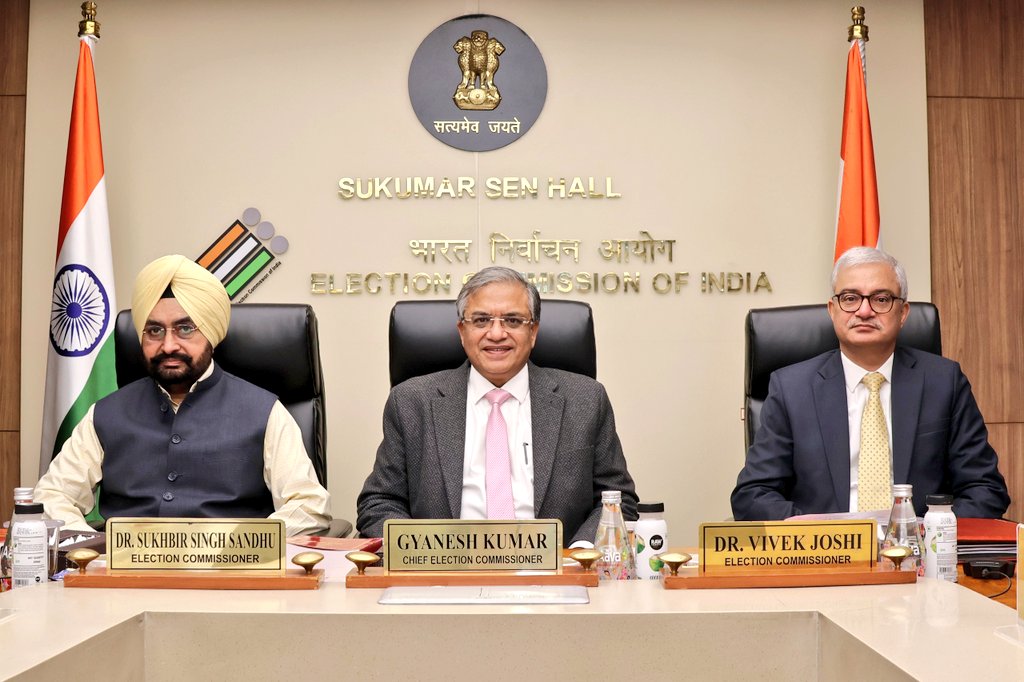
- The Election Commission consists of the Chief Election Commissioner and other Election Commissioners.
- The Chief Election Commissioner and other Election Commissioners shall be appointed by the President.
- When another Election Commissioner is so appointed, the Chief Election Commissioner shall act as the Chairman of the Election Commission.
- The President may, on the advice of the Election Commission, appoint such Regional Commissioners as he may deem necessary to assist the Election Commission.
- The conditions of service and the tenure of office of the Election Commissioners and Regional Commissioners shall be determined by the President.
From 1950 to October 15, 1989, the Election Commission functioned as a unicameral body consisting of only the Chief Electoral Officer. After the minimum voting age was reduced from 21 to 18 years, on October 16, 1989, the President appointed two more Director Election Commissioners to share the workload of the Commission. Subsequently, the Commission functioned as a multi-member body with three Election Commissioners. However, in 1990, the post of two Election Commissioners was abolished, and the situation returned to normal. Two Election Commissioners were again appointed in October 1993. Since then, the Commission has functioned as a multi-member body with three Election Commissioners.
Their term is six years or until they attain the age of 65, whichever is earlier. They may resign at any time or be removed before the expiry of their term.
Election Commission Freedom
Article 324 of the Constitution provides for the following provisions for the independent and impartial functioning of the Election Commission:
- The Chief Election Commissioner has the security of serving his or her fixed term. The Chief Election Commissioner can be removed from office only in the same manner and on the same grounds as the removal of Supreme Court judges, and not otherwise. In other words, he or she can be removed by the President on the grounds of misbehavior or incapacity after a special majority resolution is passed by both Houses of Parliament. Therefore, he or she does not hold office during the pleasure of the President, although he or she is the one who appoints him or her.
- The conditions of service of the Chief Election Commissioner cannot be altered to his or her disadvantage after his or her appointment.
- Another Election Commissioner or Regional Commissioner can be removed only on the recommendation of the Chief Election Commissioner, and not otherwise.
Although the Constitution provides guidelines for the Election Commission to function independently and impartially, it also has some shortcomings:
- The Constitution does not specify the qualifications (legal, educational, administrative, or professional) of the Election Commission members.
- The Constitution does not specify the tenure of Election Commission members.
- The Constitution does not prohibit Election Commissioners from taking up other appointments by the government after retirement.
Powers and Functions
With regard to elections to Members of Parliament, State Legislatures, the offices of President and Vice President, the Election Commission’s powers and functions can be divided into three categories:
- Administrative
- Advisory
- Quasi-judicial.
In detail, the powers and functions are as follows:
- Determining the territorial area of constituencies throughout India based on the Delimitation Commission Act of Parliament.
- Preparing electoral rolls from time to time and registering all eligible voters.
- Determining the date and schedule of elections and scrutinizing nomination papers.
- Granting recognition to political parties and allotting election symbols to them.
- Acting as a court to resolve disputes arising out of matters relating to the granting of recognition and election symbols to political parties.
- Appointing officers to investigate disputes related to the electoral system.
- Establishing a code of conduct for parties and candidates during elections.
- Developing radio and TV programming to promote the policies of political parties during elections.
- Advising the President on matters related to the disqualification of Members of Parliament.
- Advising the Governor on matters related to the disqualification of Legislative Council members.
The Election Commission is assisted by Deputy Election Commissioners. They are drawn from the civil service and are appointed by the Commission on a tenure-track basis. They are assisted by Secretaries, Joint Secretaries, Deputy Secretaries, and Under Secretaries working in the Commission’s Secretariat.
At the state level, the National Election Commission is assisted by Chief Electoral Officers, appointed by the Chief Election Commissioner on the advice of state governments. Below them, at the district level, is the Collector, the District Election Officer. He appoints the Election Officer for each constituency in the district and the Presiding Officer for each polling station.